Saturday, May 15, 2010

Absolute Sandman Volume 2

One-sentence summary: Do I have to do this for Sandman?

Is there anything I could possibly add to the conversation about Sandman? It's gotta be one of the most analyzed comics of...well, ever. This collection contains some of my favorites (Seasons of Mist, for instance), and I absolutely adore the Absolute series from DC. It really is a premium product. Beyond just the enhanced size, this collection has about 100 pages of extras, 10 of which are a never-before-reprinted story from an old Vertigo special I hadn't read (and it was quite nice).

Seriously, though, it's Sandman. I really can't imagine anything original to say about it. Walking through the script of the issue where Lucifer forsakes Hell was more revealing than I thought it'd be, particularly in regards to the details in body language between Dream and Lucifer that were entirely purposeful (also amusing was Gaiman's tangent on how Lucifer could have his own series, but he didn't see it ever happening for legal reasons, which apparently got resolved).

I miss Sandman. There were a wave of comics from the 80s to early 90s -- Swamp Thing, Sandman, Starman, and probably some others I'm not remembering -- that allowed the main character to sort of step away from the series for a few issues, serving in an entirely perfunctory role as new or side characters romped away in a full-fledged story. When I'm reading back through these, when they're done right, it usually works so well and gives the comic a nice difference. I imagine month-to-month it might be a little more grueling for a fan, but maybe not.

One thing I hadn't noticed about Sandman when I first read through it years ago was how much variance the art has. I mean, it's almost always top-notch quality, but every story has its own artist that develops a unique feel for the story. It really helps give Sandman that episodic quality which allows for such different changes of tone between plots. The only thing that bothered me were in-story switches, which I think may have only happened once.

Anyway, it's a fantastic comic published in a fantastic format. Even at $60-100, I think it's worth it (but then again, I spend too much money on comics).

Saturday, May 8, 2010

Get a Life

One-sentence summary: A wonderful comic, gently touching on seriousness without ever wading into it.

Sometimes I buy comics because they're by writers I trust or heard good things about; usually it's because they're collections of series that I've read in single issue form.

Occasionally -- just occasionally -- I will buy a comic for no conceivable reason. Get a Life found its way onto my Amazon wish list at some point, but I couldn't tell you how. When making a large purchase once, filled with expensive hardbounds from the Big Two, I threw in a used copy of this that was being sold for about $4. Of all those comics, I've enjoyed it the most so far.

The premise is simple: Mr. Jean, our protagonist, is a 30-something bachelor who just published, to some limited critical praise, his first major novel, and now he's trying to figure out "what next."

The stories are told in various vignettes, but with the plots and character arcs spanning across the entire book. Some are out-and-out comedic -- a series of gags, for instance, where Jean is suffering from insomnia and an unhelpful friend tells him to think of hippos in love -- while others are mostly serious. The book has a light tone overall, which fits the material. I've been harping on this quite a bit lately, but the combination of droll humor and cartoon-y art lets the pair of artists/writers deal with heartbreak and growing older sincerely without dipping into the maudlin.

It is a uniquely French book. French culture has this majestic ability to sweep you gently into it, so that while you're being entertained you find yourself less aware of it. I find this manifest in M. Hulot's Holiday, in the Maigret books, and here with the life of M. Jean.

Tragedy is too serious of a word, but it was very saddening for me to learn this is the only volume of the M. Jean series translated into English, and, given that it was published 4 years ago, I doubt there are more forthcoming anytime soon. However, since it's available for less than large mocha at Starbucks, I say it's definitely worth picking up.

Wednesday, April 28, 2010

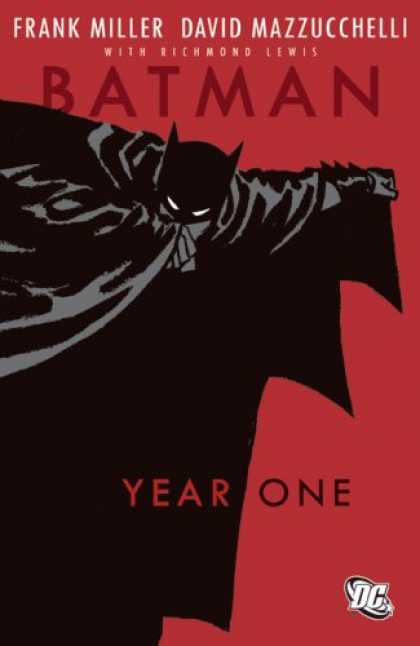
Batman: Year One

One-Sentence Summary: Um, it's Batman Year One, I don't need this.

Several of the next few posts will be "Classic comics I somehow have not read yet" so withhold judgment all zero of you. This night's edition is Batman: Year One.

Batman: Year One is by Frank Miller (Sin City, 300, Dark Knight Returns) and David Mazzucchelli (Um, this and Asterios Polyp and a couple other things?) and is Miller's go at writing a 4-issue origin story to Batman. Awesome.

To be honest, it's tough for me to know how influential this comic was. The Batman that Miller writes here more or less is the modern Batman w/some inexperience. This comic came out the year I was born, so I have no idea how people thought about Batman before this, or what his origin story was like, tonally, etc. It's fairly difficult to capture that sort of impression after something else has already been etched into you (it's like how it's impossible not to read old X-Men issues as a statement about minorities, even if they weren't intended that way until Claremont). I think it says something that this comic was so influential it could easily have changed how I think about Batman (which is often) without me even knowing.

It holds up fantastically. The recoloring helps (I have no idea when that happened, but I'm glad it did), but Mazzucchelli's art stands on its own merits incredibly well. Miller paints the scene very well showing not just why Batman is, but why he was needed, and draws a parallel between Batman and Commissioner Gordon that works well and hasn't really been expanded upon much (they're seen more in a symbolic relationship nowadays, I would argue, vs. serving the same purpose).

I really like Mazzucchelli's Batman cowl. I dig the old-school stylings, and he really works them well here. It's a sort of false-retro style that wouldn't really bloom, I think, until Cooke (though someone who knows comics better than I could probably tell me why that's wrong).

Can I make a complaint? I don't really get Catwoman's purpose here (except to fulfill the Law of Miller). I sort of see the idea of Batman inspiring others, thus creating his own need (a theme that's used much more openly in other stories), but the story does parallels with Batman and Gordon so well anything additional seems more cluttered than anything else. It feels like an idea that could've been interesting on its own in a sequel, but in here, it just seems unnecessary, especially given the story's otherwise spartan use of subplots.

Also: what's up with that son? Such an odd facet of Gordon to be completely forgotten, especially given its central placement w/in this story, considered a seminal Batman book.

And, really, that leads to an odd contradiction with this book: it will forever be loved, and rightly so, by Batman fans as one of the key trades to own, along with The Killing Joke and Dark Knight Returns, and tonally it more or less set the tone for the Batman we still have. However, most of the elements actually used here -- the relationship between Gordon & Batman, Gordon's son, Gordon's silent acknowledgement of Batman's identity -- seem to have disappeared.

Oh well. Batman's currently awesome, and this Batman was awesome, so, really, who am I to argue?

Monday, April 26, 2010

Preacher: Ancient History

One-sentence summary: This collection of the Preacher specials is solid, if probably unnecessary.

I haven't read Preacher in years, so I've been going through it again recently. It holds up pretty well as a series -- definitely Ennis's magnum opus.

A big part of Preacher, though, is the fascinating long-form narrative. Another equally important part is Steve Dillon, whose art is key to the story's tone. What's interesting, though, is how well these three stories work despite that. They're a reprieve from the main Preacher -- a side-road to travel -- but they're still a good read.

Well, the Saint of Killers 4-parter is a good read. Arseface's origin and a story featuring Jody and T.C. are pretty lackluster. They're a bit of cotton candy; sort of enjoyable, but there's nothing to it.

The Saint of Killers story -- there's some amazing Preacher work. Firmly entrenched in the bizarre theology of the Preacher universe, while a complete embrace-and-rejection-of the old Westerns that Ennis loves so much, it just works. It's a story that's simultaneously awesome and terrifying, over-the-top but creepy. It serves its purpose as a legend w/in the Preacher world, giving us an interesting background on the Saint of Killers that we can choose to believe or not, while giving us an interesting amoral tale. It's the key to the collection, and really what makes the book worthwhile.

That being said, I do wonder about the placement of this trade within the series. As I said, it's been awhile since I read Preacher, so I'm not entirely sure if what comes immediately after this has any relevance to the going-ons of this book, of if it just so happened that some of these issues were published during the issues in trades 3 & 5, so they threw them in here. I don't know. If they end up not having any relevance, I sort of question making them a numbered part of the set, and not just their own separate trade -- but, meh, it was worth it for the Saint of Killers story.

Wednesday, April 21, 2010

Atomic Robo Volume 1

One-Sentence Summary: Hurray for Atomic Robo!

I'll admit it: I've got a major soft spot for this comic. Not only is it by Brian Clevinger (whose webcomic, 8-Bit Theater, is super-fantastic), but it's everything a superhero comic should be.

This doesn't read like the first few issues of an independent comic. It doesn't look like it, either, or even feel like it. You have a (seemingly) fully-developed world with characters with rich backgrounds, and the action sequences are well-constructed.

If I have any complaints, it's in the nitty-gritty. I think that background characters lack faces is a bit of a distraction, even if it's more of an artistic choice than a shortcut. Because this is a volume that's really about introducing Robo himself, the side characters sort of get passed by. You have some wacky dialog from them (including a great, on-the-side discussion of imaginary physics), but Robo really dominates.

The good part of this is Robo is a great protagonist. The comparisons of this comic to Hellboy are rife and apt, but I will say it: Robo is a better character than Hellboy. Stories aside, Hellboy is a much more reactive character, while Robo is front-and-center of his world. Robo has no dominant characteristic -- sure, he jokes and fights, but he's an intelligent character, and, in my favorite scene of the volume, you feel the weight of being an 80-year old ageless robot.

The art works so well for this series too. Much like Invincible, or the 90s Deadpool when McGuiness drew it, this relatively bright, relatively cartoon-y style is very liberating on the story. Not only does it allow for fairly ridiculous things seeming ordinary (Robo himself would be a bit more dehumanized with a more realistic style), but it also brightens the story a bit and really highlight the humor-element.

As far as the trade goes, it's a pretty standard job: 15-ish dollars, 6 issues, the b-material from the issues is included along with a few pages of concept art. Glossy paper, though, so that's nice.

Atomic Robo is one of the up-and-coming comics, and Clevinger is a rising star himself. I won't pretend to guess the future on it: it could go the route of Hellboy, and become huge; it could go the way of The Goon and begin to explode, then collapse for creator-based reasons (yes, I know it's still limping along); or it could be like so many Dark Horse projects of the 90s, and be popular and critically acclaimed, only to be forgotten borderline-instantly (Concrete or Monkey Man & O'Brien anyone?). It has the potential to do any of these. I know which route I'll be rooting for.

Tuesday, April 20, 2010

Complete Crumb Volume 2: Some More Early Years of Bitter Struggle

One-sentence summary: Despite some peaks, this really is an edition only for the hardcore fans or completionists.

In case you don't know, the Complete Crumb Comics is a 17-Volume series of all of Crumb's work that could legally be gathered by Fantagraphics into these 120-or-so page volumes, up till a certain point in his career where copyrights start to bump into each other. As a collection, it'll take awhile to assemble if you don't want to pay outrageous mark-ups on them (they drift in and out of printing, with prices that fluctuate accordingly, though realistically they rarely go for more than 25 in an eBay auction).

Now, when I say they collect all of his work, I do mean all -- the first volume has high school doodles and attempts at comics with his brother, and this volume is still him in a very early phase of development. I'm not saying the comics aren't interesting -- Crumb's unique take on powerful women is here less embroiled in a trope and instead much fresher, as in his longer Mabel story -- just that, as a rule, it's pretty meh stuff.

Fritz the cat, while appearing briefly in the first volume, really starts to come into his own here; the final sequence in the book is an incredibly disturbing story of him going back home after an off-panel fall-out with his current teenage pet/girlfriend, a story which ends suddenly and I'm not sure I want to see the conclusion of, truthfully.

You're mostly getting comics that are somewhere between doodles and fully developed amateur work, and the last 50 pages are mostly sketches (gorgeous sketches and covers, sure, but still just sketches). Among the nicer bonuses of the Complete Crumb sets, though, are the 6-7 (large) page introductions done by people relevant to Crumb's life at the time of the material. I'm not a huge Crumb buff, so I'm not sure how readily available the material they present is, but I always enjoy the intros.

Crumb's an impressive enough cartoonist that even this early material, almost 50 years after it was first written, is interesting on its own right; however, for what you get in this trade, it's not that interesting. I'm definitely looking forward to the next volume, in which we see the bulk of the Fritz stories.

Friday, April 16, 2010

The Fabulous Furry Freak Brothers Omnibus


One sentence summary: Some hits and some misses, but for the price well worth it to read these darlings of the old underground.

I am not an expert in the underground comix of the '60s-70s. A large reason for this is how generally unsuitable for modern-style reprinting is the original material, if quality copies are even available. That's part of what makes this (and the Complete Crumb collection, for that matter) such a treasure: these are gen-u-ine cultural artifacts.

That being said, it's not like reading this is similar to, say, reading Piers the Plowman or some other Medieval writing suitable only for historical perusal. These are vibrant characters in hilarious situations, most of which manage to deal with drugs.

What struck me when reading these, particularly the first couple of hundred pages, is that the joke of a page would be straight from a newspaper funny: a mistaken identity, a hilarious inversion, etc. These managed (and still do!) to have an edge by making these situations darker and about material never printable in a newspaper funny. An example is when one of the trio, off-panel, shoves a cop out of a third story window thinking it's Fat Freddy in costume, leaving the brothers in the last panel dots on a mountain, hiding out in the wilderness until the heat dies down. The punchline is so old it's vaudevillian, but it manages to twang a new chord by adding the darker element.

That said, shockingly, not all 40-year old hippie comics have aged well. In particular, the mega-arc that takes up over 1/6th of the book, "Innocents Abroad," manages to be over-serious and silly at the same time, and not really in a good way. Despite having the best art of the entire set, and being the best-preserved (some of the black-and-white scans are fairly blotchy, though certainly readable), it reads the most out-of-date -- clearly a product of the cynical '80s.

I love having read this book. When one reads a great novel, or something almost entirely uncorrelated with the times (such as the typical superhero comic), there's a timelessness about it, a disconnection from its own history. For good and for bad, the Freak Brothers are a product of their times, and more importantly a snapshot of those times. Shelton has no way to turn off his writing from being a reflection of his concerns at that moment; the Freak Brothers are the hippocampus of the comix brain, spitting out whatever's most current, and in many ways this is as fascinating to me as any number of pot-jokes.

All said, if you can still find it at the retail price, it's a steal. It's recently gone out of print, which is a shame, though I have no idea if there's enough of a demand to keep prices high (I'm looking at you, X-Statix trades).

Thursday, April 8, 2010

Supergirl: Cosmic Adventures in the 8th Grade

Note: In an attempt to balance my desire to write about comics with the time demands of, well, life, instead of my somewhat-crazy attempt to review every comic book that this blog started as, I'm just going to try to write reviews of whatever I happen to have just read. This should be a reasonable 1-2 posts a week. Let's see if I can manage!

One-sentence summary: An ignored comic, but one of the single best superhero stories to come out of 2008 -- no, really!

I think kids' comics get a bad rap on a consumer-level. Critically, they're fairly appreciated (Tobin and Parker's work on the Marvel Adventure line comes to mind), but even this is hit or miss. I think this comic is a great example of that.

Let's be honest: there aren't a ton of well-written superhero comics about girls out there. Unfortunately, part of the reason for this is that they simply don't sell well (Slott's She-Hulk, Palmiotti's Power Girl, etc) even when they are good. I think it's a bit of a self-sustaining cycle: few comic buyers buy girl-centric titles because they generally aren't well-written, thus lowering the demand for girl-centric titles, thus lowering the chances for a company to strongly support a title, and so on. This isn't a new phenomenon, nor is it one that really shows signs of going away any time soon.

I lead off on this tangent because one of the most important aspects to this book is that it somehow manages the miracle of never once falling into a girl-comic cliche, all the while being, through-and-through, a girl-comic.

Maybe it's due to my absence from writing, but I can't really get describe how much I adore this book. The characters are solid, and when the emotional moments are there, you feel them. How many times does this happen in a kids' comic? Even Lex Luthor gets a heart-wrenching line at the end. One of the primary "enemies" of book -- Belinda Zee, her "evil" double -- really is just misunderstood, but you're never hit over the head with that, you're never forced to love the character, but at the end you sympathize with the position into which she's been created\. The emotional moments are sprinkled throughout the book, but at no point do they seem out of place or undeserved or overwhelming.

Now, lest you think it's a maudlin work, let me talk about the comedy. This is what first got my attention with the book; like a lot of kid comics published today, comedy plays a larger role than in mainstream superhero books. The main source of humor throughout the series is Linda Lee (Supergirl)'s image thought bubbles, usually showing her daydreams of an idealized super-heroic self, with the absurdity a misplaced 14-year old might have (one of my favorites was her fantasy of being moon Supergirl stopping moon robbers from robbing the moon bank. On the moon). The series also plays with the inherent absurdity of superhero books, embracing it fully, without any meta-acknowledgment, eventually giving a totally acceptable explanation for all the surreality that had occurred before (just in case there were readers wondering how, for instance, a piece of kryptonite shown through a projector could create an evil double).

But, in case you do like a dash of meta in your comics, the depiction of the 2-d world in the climax as crudely drawn crayon drawings with childish dialog ("Karate chop!!") might appease you. Or if you're a huge DC-canon nerd, you can enjoy the reference in the final issue as a giant hand reaches out through the multiverse. Maybe you simply yearn for the old funny editor note asterisk call-backs -- they're there too.

My point is: this book really does have it all. I'm not easily impressed -- at any given moment, the Big Two are putting out maybe a half-dozen books I really dig -- but this is great stuff. I can't recommend it enough, and it's only $13 retail ($11 on Amazon -- just sayin'). Give it a try. It's a nice, self-contained story, that's friendly to all ages, particularly a good comic for girls, but with more than enough substance to satiate any level of fan.

P.S. Looking up the writer, I see that he?she? has gone on to write some other critically appraised children's comics -- Batman: The Brave & The Bold, and The Incredibles.

Thursday, November 12, 2009

Strange Tales

One-sentence summary: Regardless if you like indies for their off-beat humor or their unflinching address of real themes, these stories will serve you well.

I wasn't sure what to make of Strange Tales when I heard it announced. So many indie creators have an anti-superhero passion that I wondered if it would be a self-loathing collection, but that was never the case. The closest you have to that are the direct parodies, like the Spider-Man redux in issue three, or the Kupperman story in issue one, but even these aren't done mockingly. Instead, you mostly have stories like Bagge's three-part Hulk story where Hulk is torn between two vastly different women who want bizarrely similar things (side note: Bagge did this story years ago, and Marvel just got around to finding a venue to publish it, deciding it was too racy for inclusion in an all-audience Hulk revue). I particularly liked the Hornschemeier Molecule Man story as far as the more serious stories are concerned. Though only two pages, Jeffrey Brown's Fantastic Four story probably had me laughing the most of any thing in the three issues.

All in all, it succeeded quite well at what it was going for: give general comic fans a different, generally humorous take on some beloved characters while introducing several indie creators to a larger crowd (some, like Sakai, most nerds at least peripherally know, but I had actually never heard of Hornschemeier prior to this, along with many of the others).

I unabashedly like revue books, at least when they're not just an excuse to dump some online-exclusive stories. I think it does a mind good to read comics (superhero and not) not written in either 22 or 110/132 page increments. For me, while I consider myself a fairly decent comic nerd, I really don't have a ton of knowledge of the indie scene due to various reasons, so this easy method of getting to know some names and styles was worth it for that alone.

Monday, April 13, 2009

Eisner Thoughts

Oh life -- you sure make writing a blog no one cares about or reads difficult.

So the Eisner nominations came out, and did you hear? People like to talk about them. Here's a few cents of thought (given inflation, it's probably considerably more than 2).

Madame Xanadu? Really? This book has never seemed greater than average and, unlike Air or Unknown Soldier, it doesn't seem to be trying to be much more. For one thing, it's stuck in the same situation as, bizarrely, Cable. They're both books which, while Xanadu probably has more potential than Cable, are hindered by the plot device of time-jumping-forward. It's simply a messy way to tell the story. In both, the characters have gone forward hundreds of years at a time, but don't stay at any of the times long enough for the reader to care. What happens is a mixture of a too-long arc (in Cable, it's just now closing up after 10+ issues, crossover, and related 2-issue miniseries, in Xanadu we don't have her in the present, but we're now into the 20th century) w/too short of stories. All in all, a completely OK book.

The best continuing series is just a bizarre collection. We have one of the best limited series of last year represented, so that's...good? W/the exception of Monster, I've read these series over the last year (I've got plans to catch up on Monster soon, it just hasn't happened yet). I've thought Thor was a pretty solid read, but there are definitely some better books (Incredible Hercules, anyone? Captain America? And that's off the top of my head, from other Marvel titles). Usagi Yojimbo just seems a bit random, though I do like the book, so I'm not going to complain too much.

I guess what this comes down to is the fickle nature of the Eisners. Selected by a very limited group of people pulled from a not-quite-as limited pool which differs year-to-year, you're not really getting a guarantee, as, well, sometimes really smart people who know their craft can have weird taste (if I were less lazy, I'd link here to Ebert giving Garfield: A Tale of Two Kitties a 3-star review).

What I'm saying is that Madame Xanadu is a Garfield movie.

Thursday, August 14, 2008

Green Lantern Corps #27

One-sentence summary: I had my doubts about this book post-Sinestro Corps, seeing as how dominatingly brilliant that was, but Tomasi delivers a good superhero cop book.

I really like what they've done with Green Lantern Corps. There's a lot of pitfalls in a book like this (to name a few: letting it become a series of one-shots about side characters from Green Lantern, letting it become all about a major side character, like Guy Gardner or someone, or, most obvious of all, letting it play second-fiddle to the main Green Lantern book). I think it's a credit to every writer who has been on it that these haven't happened. Instead, what we have is a comic that presents a chance to tell some unique stories.

At its heart (at least right now), Green Lantern Corps is a cop book. Sure, they have superpowers, but so do most the people we see them chasing, which evens things up. Yes, there are great sci-fi elements in the stories (expressed in the art wonderfully), and the villains tend to be on the super-villain side of things, but I defend that it's still a cop book, with all the worries of the characters being like those in most crime drama.

This latest story goes with endangerment of families, which could be interesting. It also spent some time with old and new subplots, one of which provided some necessary light-heartedness. All in all, I'm excited about the issues to come, but this issue was more of a nice segue between two arcs, which isn't bad in it of itself, but...it's tough to have strong feelings about a hallway. That being said, the art was great as usual. Just keep an eye out for later issues of this arc. It's probably safe to assume it will be good. That's just a great thing to be able to say.

Friday, August 1, 2008

Thor #10

One-sentence summary: The weighty style of Straczynski really shines in slow-moving saga of the gods.

You know, regardless of whether or not you like it, you've got to give Straczynski credit for taking on the challenge of crafting an original epic in comic book form. He is taking Thor on not as a superhero but as a god in a world of superheroes.

However, this style is definitely not for everyone. For one thing, this is a very slow moving story with a fairly low amount of action. For another, as I said, this isn't really a superhero book. If anything, the one encounter with superheroes the book has had stated pretty intensely just that -- Thor is not a superhero and is not going to concern himself with superhero worries.

This issue is dialogue intense, with only a small amount of true progression through the story, though what's there is important.

One thing that will keep some readers from getting into this is the obviousness of various aspects. Of course Loki is planning something; why can't those who have dealt with him for millennia see that? The answer to that is mythology itself. As anyone who read the old Norse myths knows, many times the evil is obvious, many times the plots transparent, but the gods go on through it, seemingly oblivious to the obvious. Why? There's a number of answers you can find, sure, but I'd say the best is just "because that is what they do." Much like a superhero, a god's characteristics are determined through the stories told about them rather than through any intrinsic characteristics. Out of these stories emerge, along with the characteristics, oddities that are accepted because they are. Why do the gods plunge through a plot thick with evil with their mythic intensity? For the exact same reason no one has bothered to compare the face of Superman with that of Clark Kent.

I like Thor. I read enough comics that I'm not dying for the next installment of any of them, no matter how good -- I can have the patience to wait. Thor demands that patience, which may reasonably too much for some, but I can wait for this story to complete. A story of gods is nice amongst the superheroes.

Thursday, July 31, 2008

Project Superpowers #5

One-sentence summary: Dynamite's public-domain superhero project is moving along, this issue bringing the elements together to close this chapter and set the stage for the various spin-offs.

For me, after having them built up my whole life, Golden Age comics were a bit of a disappointment. Sure, there were a handful of ones with some interesting gimmicks or art, but the Golden Age of comics was golden only in terms of sales; the stories were formulaic, the characters massively derivative from each other (with a few gems), and the art generally as quickly done as possible.

However, Ross and Krueger sat down with these raw materials and thought up an intriguing universe. They took each character and flushed out their personalities, their flaws, and what they should be like in a post-WWII environment. Taking these characters, drawing the lines on good and bad, and plotting things out, they've created a truly great universe. Taking forgotten characters and turning them into original masterpieces is a comic tradition, from Moore's Swamp Thing to Morrison's Doom Patrol, and that's exactly what they've done here.

This issue is much less plot-intensive than ones in the past, with many of the story developments taking place in the background, allowing us to see these fighters in what proves to be their element; brawling. Normally I get bored with issues like these, but given the number of characters in any number and style of fight, I really loved every panel of this.

Project Superpowers is one of the better titles of the year, and definitely among the top superhero comics out there. Given no hype at all, this Golden Age-themed comic has yet to disappoint me.

Reign in Hell #1 (of 8)

One-sentence summary: This ambitious mini-series begins with a declaration of intent, giving the reader a good feel for where it wants to go, and it's delivered well so far.

Hell is unfamiliar territory for DC. Not so much for Vertigo, no, but as a whole DC has left its Hell rather uncharted, with just an occasional demon popping up here and again. Consequently, Reign in Hell could supply something rather unfamiliar to mainstream comic fans -- an obvious world w/in the comic universe that remains uncharted.

First off, I was glad to get my dose of Shadowpact in this issue. It wasn't much, sure, but I was grief-stricken when that series got canceled, so it's just nice to see them again. There are a couple other cameos I won't spoil but were intriguing surprises to me. The art is great, with that sort of gritty detail that's been a mainstay for Hell since Bosch. The story seems solid, with definite direction and purpose, which is nice to see in a premiere issue. The dialog is...ok. I'm pretty neutral toward it; it never grabbed me, but it also never distracted me, so that balances out. What really sells this title to me is the purpose: organizing DC's Hell only to break it apart, and possibly how magic works (though that never seems to amount to much). I'd like this to reflect the events in Final Crisis, but I'm guessing it won't, since anything with even a vague connection to that series is stamped all over.

The back-up story was a bit weaker, I thought. Maybe it was my unfamiliarity with Dr. Occult, but I just found myself one step behind the whole story through; this isn't that rare for first issues, though, so I won't condemn it for that.

All said, at the end of this Hell will no longer be so unfamiliar. Whether that will add a neat element to the DCU or if it will simply eliminate one of the few true unknowns in that universe, we'll see.

Monday, July 28, 2008

Marvel Comics Presents #11

One-sentence summary: As this 12-issue arc draws near a close, the series continues to output neat one-shots and interesting arcs.

I'd like to think that I like this series for reasons that extend beyond it fitting my stunted attention span, giving me four short stories in a relatively small (30ish pages) frame.

For one thing, I like how it's done a story on the Collective/Guardian/Whatever. He seemed like he should be a gigantically important character, but just got tossed to the side; it's nice to see what's going on with him.

As a general rule, that's what I like about this. It's giving little known characters a chance to get some panels in. I imagine the Hellcat series inspired the current Hellcat mini, which is neat, and I'm enjoying the Machine Man going on right now. The one-shots, while sometimes a bit odd, are usually at least a little enjoyable. This issue had a one-joke Stingray story, but it was still fun. Vanguard (the other 12-issue story) has been good, but this one ended somewhat crazily -- I'm looking forward to the conclusion.

All in all, I'm hoping next issue isn't the last, but I'm not sure. I haven't checked the solicitations. Regardless, it's been a good 12-issue run -- attention span notwithstanding.

Friday, July 25, 2008

Glamorpuss #2

One-sentence summary: Dave Sim's bizarre half-satire/half-stream of conscious art essay continues, though somehow less satisfying than last issue.

I thought I'd do a review on a more indie comic, though it's certainly getting its share of coverage as it is Dave Sim, of Cerebrus fame, doing it. I actually really get a kick out of the stream-of-conscious art essay portion of it, as I don't know a ton about that era of artist (it's essentially about the pre-comic book artists of the 30s). In general, his parody of Cosmo and ilk aren't too far off, though I thought this issue's rant against anti-depressants was a bit weird (though, honestly, if you're familiar with Dave Sim you know to expect weird).

What Sim's doing here is certainly ambitious. He is, essentially, trying to revive a long-dead art style single-handedly. In doing so, he's also trying to personally work through the whys and the hows of all the bigger name early artists (Hal Foster, Alex Raymond, etc). In order to give some sort of structure to the title, though, he's including a few parodies of fashion magazine-style articles, in particular with the cover of each issue. I think this is hit or miss and much prefer his essay portion, but that's me, I'm sure there are others who just like the Glamorpuss portion.

All in all, I think there is a definite audience for this book. For someone either interested in comic art theory or early comic history would probably like this. However, someone looking for the average comic is going to be feeling disappointed, but, then again, why are they buying an indie title by Dave Sim?

Ambush Bug: Year None #1

One-sentence summary: How many jokes you get from this book is essentially like a scale of how much of a comics nerd you are -- casual readers beware.

Ambush Bug is one of those characters you either love, hate, or have never heard of because he's almost as obscure as the jokes he makes. If you doubt my emphasis on the obscurity of the jokes, here's a list of some of the references I caught and remember off the top of my head:
  • Sugar & Spike (comic from early Silver age about a couple of kids)
  • Several references to earlier Ambush Bug mini-series (such as Cheeks, or Jenni DC)
  • Girlfriend-in-the-fridge
  • Captain Carrot
  • Etc
So, I defend that this book is really for die-hard comics fans only. There'll be plenty for them to laugh at, sure, but this is probably the most self-referential book put out in the last few years; it's definitely not for the casual reader. Is that good or bad? Am I one of the ones who loves Ambush Bug, or do I hate him?

I almost feel like leaving this review on a cliffhanger in honor of him, but I'll not and just say the Bug makes me laugh. And that probably is a sign of how high on the scale of comic nerd I rest.

Uncannny X-Men #500

One-sentence summary: A daringly different direction (it's issue 500, I get to write like Stan Lee for a sentence) for the X-Men that it'll be interesting to see through.

The X-Men titles have, for quite some time, been stuck in a rut that not even the best writers have really been able to help with. Sometimes the rut has produced good stories, sure, but there have been few X-Men stories in recent years that couldn't have been from ten, twenty, even thirty years ago.

That being said, this issue really makes the reader feel as if we're on the cusp of a big change. The move to San Francisco is a really good choice, in my mind; the location makes sense and it's nice to change scenery once every few decades. Also, I really liked the idea of a shock artist using real Sentinels as a piece of art -- it really is a fairly accurate, Marvel version of shock art. Bringing back major villains is an attention-grabber too, which I'm looking forward to, and the change of the X-Men from exclusive team to open embassy (ironically similar to Genosha) is interesting. The writing style for the team, as a whole, seems much fresher than it has in quite some time, and is a major contributor to that feeling of change this issue just oozes.

That said, there's some bad stuff that's not insignificant. For one, part of what makes the X-Men who they are is that the team should experience change w/in the members. So, why is everyone (Emma Frost excepted, though she's written here as a slightly naughtier Jean Grey) on the team from at least 30 years ago? In addition to that, the green-ness of the book got on my nerve. I'm not this monstrous tree-burner, but it was pretty irritating in this issue. I was fine until they throw a car and the line "Did it have to be a hybrid?" was said...ugh. We got it during the two pages about it earlier, it doesn't have to be stressed that much.

Brubaker and Ellis seem to be dragging the X-Men out of their rut. Whether they'll do a good job with that or not remains to be seen, but as they're two of my favorite writers, I'm optimistic.

Justice League of America #23


One-sentence summary: The second battle against Amazon continues in a truly ridiculous fashion that goes essentially nowhere.

Alright, first off, I am biased on this issue. I'm, for whatever reason, just not a fan of Vixen, so how prominently they're trying to feature her doesn't jive well with me regardless of story quality. That said, this issue is pretty weak. It opens, essentially, on Amazo taking on the Flash, which was actually somewhat interesting. The main glaring problem is that they try to cover up a potential problem (one that always comes up with characters like Amazo) with another one; w/Flash's super speed he could easily kill everyone, but if Flash can take it away why didn't he do that before getting himself beaten to a pulp? I know I know, it's a comic book, and normally I don't take issue with these sorts of things, but clearly the entire sequence was done entirely because the writer had taken issue with a similar problem. C'est la vie, all the same.

I've admitted in the past to being a story-lover, and it's true, so when an entire issue features nothing but a fight going nowhere, yes, I tend to get irritated. Maybe other people love meaningless fight issues? Personally, I'd at least require really original art to make up for such a thing. Instead, the art here...meh. I didn't care for the overly sketchy, lots-of-muscle-lines, style back when it was popular in the '90s. Now I don't care for it and it feels dated.

I'm sad about not liking this series right now. As a concept, I love good superhero teams, and I'm pretty ok with the current Justice League line-up. so it's actually a bit of a challenge for me not to like this series. However, using Amazo twice in less than two years (not to mention the arc he had in the now-canceled JLA Classified) is overkill for a pretty lame character (sorry everybody, but any mimic-type character is inherently lame due to the fact they never make any sense, even in comics).

I might be biased going into this, but, sadly, I'm more biased towards liking this series, and I still can't say I even vaguely like this.

Thursday, July 24, 2008

Avengers: The Initiative #15

One-sentence summary: This series continues the Secret Invasion tie-in arc with a rather blah issue.

I've been a pretty big fan of the last few Initiatives. I thought they were fairly tightly scripted with a good mix of action and humor. Last issue did the same, while being, what I thought, a pretty good tie-in with Secret Invasion that might actually have some implications. This didn't surprise me, since I was pretty happy with their tie-in with World War Hulk, praise I gave exclusively to them.

That being said, this issue was a let-down for the same reason Secret Invasion as a whole is sort of bleh, and that's that nothing happened. Great, we get some background on a character for an issue. Woo. Awesome. Is it particularly amazing background? Not really, no. It's ok. It'd be ok if it had been a page or so of exposition in order to use it later in the issue/arc as material, but it's clearly just a one-shot with this character. Ugh. I'm so tired of everything having to do with Secret Invasion being mired for the past 2 or 3 months in the exact same 5 minutes.

That being said, who knows -- maybe they'll finally get to do something next issue.